What to Do With Old Office Furniture: 4 Real Options
Most organisations believe they manage their old office furniture responsibly. The data says otherwise. In a 2025 industry white paper, 86% of organisations said their furniture management was sustainable, yet half were still sending unwanted furniture to general waste.
Most of the time that is not a values problem. It is a knowledge gap. People do not know what the options are, so the easy route wins and serviceable furniture ends up in a skip.
The scale is hard to picture until you see it. UK offices send around 300 tonnes of furniture to landfill every working day, including up to 1.2 million desks and 1.8 million office chairs every year. A lot of it is in good condition.
So here is the full picture. When you are deciding what to do with old office furniture, there are four real options. Only one of them is the skip.
The reuse-first hierarchy
Before the four options, one principle ties them together. Not all of them are equal, and the order matters.
The best outcome is keeping furniture in use. The next best is repairing it so it can stay in use. Only after that does recycling come in, and disposal should be the last resort. This is the reuse-first hierarchy, and it is the opposite of how most furniture is actually handled.
Get the order right and the responsible choice and the cost-effective choice are usually the same one. Here is how that plays out across the four options.
Option 1: Buy used or refurbished instead of new
Good commercial office furniture is built to last 15 to 20 years. A great deal of what gets scrapped has barely started its working life.
If you are fitting out or expanding, buying refurbished gets you the same desk, task chair or storage unit, often a premium brand, at up to 80% off the price of new. The carbon cost is a fraction of new too, because the energy-intensive part, manufacturing, has already happened.
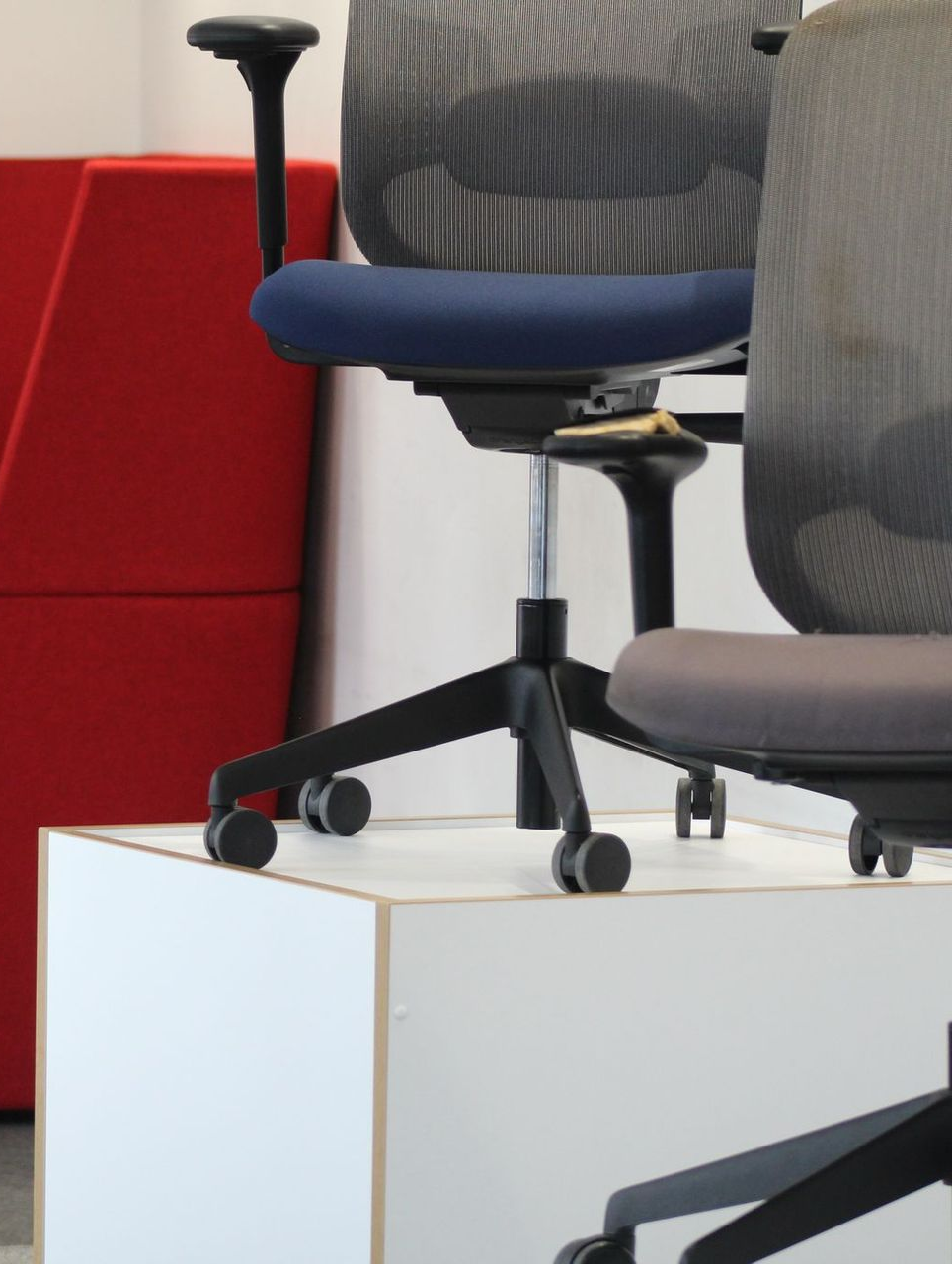
This is the option most people overlook entirely. They assume refurbished means worn or second best. In practice a professionally refurbished chair is cleaned, repaired, tested and guaranteed. We supply used and refurbished furniture and do not sell new, because in most cases new is not what the space actually needs.
When it is the right choice: any time you would otherwise buy new. Fit-outs, expansions, replacing tired items.
Option 2: Refurbish what you already own
You do not have to replace furniture to refresh a space. Often it can be repaired, re-covered or made good for far less than buying again, and it keeps assets you already paid for in use.
The maths is usually straightforward. Refurbishing a quality chair costs a fraction of replacing it, and the result is a chair that performs like new. Across a floor of furniture, the saving adds up quickly.
Minor work such as new castors, arm pads or gas lifts can be done on site with little disruption. Larger refurbishment is collected, restored at our Preston workshop, and returned.
When it is the right choice: when your existing furniture is good quality but tired, and replacing it would cost more than restoring it.
Option 3: Clear it properly
When you are clearing a space, the company you choose matters more than the price they quote. The difference between a good clearance and a cheap one is what happens to the furniture after it leaves your building.
A proper office clearance sorts everything before anything is discarded. Items fit for reuse or resale are kept in use, and that recovered value can offset the cost of the clearance itself, sometimes down towards nothing. Only genuine waste moves further down the chain.
A cheap clearance does the opposite. It charges you full price to remove everything, then quietly sells the good items and keeps the proceeds. You pay twice: once to clear, once in lost value.
Three things move a clearance price more than anything else: access (a ground floor with a loading bay is cheap, a third floor with one small lift is not), what happens to the furniture next (resale value can offset the cost), and notice (a planned clearance is priced fairly, a panic one is a premium job).
When it is the right choice: office moves, refits, downsizing, lease ends. Give it lead time and choose on destination, not just price.
Option 4: Recycle what is genuinely left
Whatever cannot be reused, resold or refurbished should still stay out of landfill. We work to a reuse-first, zero to landfill policy, reported by weight and number of items diverted.
Recycling sits at the bottom of the order on purpose. It is the right home for genuine waste, not for furniture that still has life in it. The mistake many businesses make is jumping straight to recycling, or worse to general waste, for items that could have been reused or refurbished first.
When it is the right choice: only for furniture that is genuinely beyond reuse, resale or repair.
Why this matters now: the 2025 law change
This is no longer only about good practice. Since 31 March 2025, businesses in England with 10 or more full-time-equivalent employees must separate their waste streams before collection. The rules are enforced by the Environment Agency, and failing to comply with a compliance notice is an offence.
Micro-firms with fewer than 10 employees have until 31 March 2027. The employee count is measured across the whole business, not per site, so a company with several small sites is likely in scope even if no single site has 10 people.
The direction of travel is clear. Wasteful disposal is getting more regulated and more expensive, not less. Handling furniture through reuse, refurbishment and resale first puts you on the right side of that shift.
Frequently asked questions
What is the best way to dispose of old office furniture?
Work down the reuse-first hierarchy. Reuse or resell what is serviceable, refurbish what can be saved, and recycle only what is genuinely beyond use. Disposal to landfill should be the last resort.
Can I sell old office furniture?
Often, yes. Quality furniture in good condition has resale value, and a good clearance company will recover that value and offset it against the cost of the clearance.
How much does an office clearance cost?
It depends mainly on access to the building, what can be resold or reused, and how much notice you give. Recovered resale value can reduce the cost, sometimes significantly.
Is refurbished office furniture worth it?
For quality commercial furniture, yes. It performs like new at up to 80% off, with far lower carbon than buying new.
Do I legally have to recycle office furniture?
Since 31 March 2025, businesses in England with 10 or more employees must separate waste streams before collection. Furniture disposal sits within that tightening framework, so responsible handling is increasingly a compliance matter, not just good practice.
One supplier. Four services. Zero to landfill.
Reuse what works. Refurbish what can be saved. Recover value where it exists. Recycle only what is truly left.
If you have an office change, refit or clearance coming up and want to talk through the options, call us on 01995 606414 or email info@coggin-sos.co.uk.